VAT Retail Scheme: A Practical Guide for UK Retail Businesses Simplifying VAT Accounting for High-Volume Retailers
Businesses operating in the retail sector, particularly those making high volumes of low-value sales, often face practical challenges when accounting for VAT.
The VAT Retail Scheme was introduced to simplify VAT reporting, helping retailers remain compliant while reducing administrative burdens.
1. What Is the VAT Retail Scheme?
As the term suggests, the VAT Retail Scheme allows retailers to calculate VAT based on daily gross takings rather than recording VAT on each individual sale.
Instead of issuing VAT invoices for every transaction, VAT is calculated using an approved method that applies the correct VAT fraction to total sales.
For example, where goods are sold at standard-rated prices, VAT is calculated using the VAT fraction (currently 1/6 of the VAT-inclusive takings). This ensures VAT is accurately accounted for without tracking each transaction separately.
The primary objective of the VAT Retail Scheme is to simplify VAT accounting while ensuring the correct amount of VAT is declared to HMRC.
2. Eligibility Criteria
To qualify, a business must:
- Be VAT-registered in the UK
- Operate as a retailer making direct sales to the public
- Typically handles
- The scheme is particularly suitable for:
- Retail shops
- Cafés and restaurants
- Convenience stores
- Pharmacies
- Takeaways and similar businesses
Retailers must sell goods or services where issuing VAT invoices for each sale is impractical.
However, businesses making mainly zero-rated or exempt supplies may not benefit from the scheme. Approval from HMRC is required before adopting any retail scheme method.
3. Types of VAT Retail Schemes
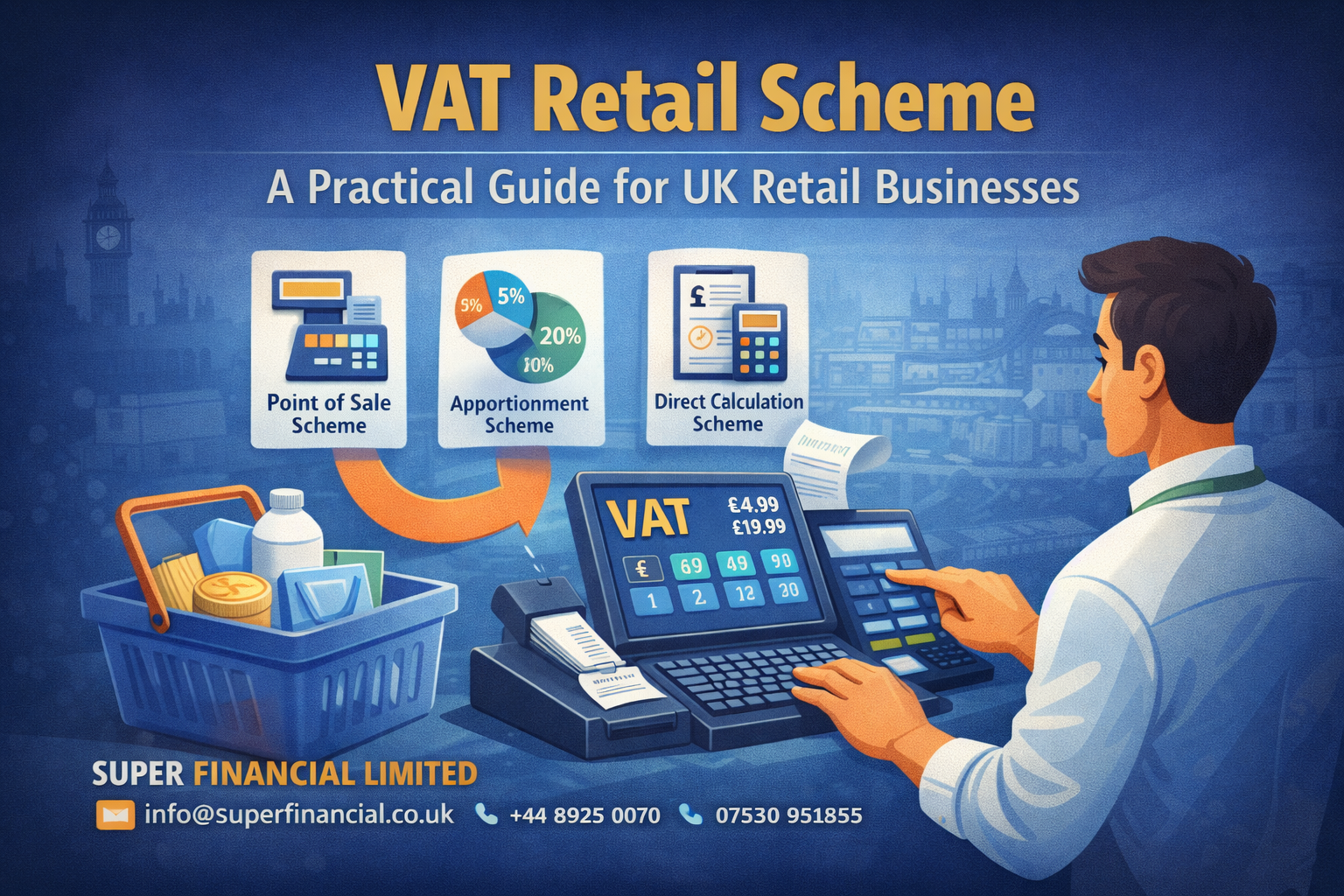
There are three main types of VAT Retail Schemes:
Point of Sale Scheme
VAT is calculated at the point of sale using tills or accounting systems that separate sales by VAT rate. Daily totals are then used to calculate VAT due.
This method is suitable for retailers with modern EPOS systems capable of tracking VAT rates accurately.
Apportionment Scheme
Used where goods are subject to different VAT rates and cannot be easily separated at the point of sale.
Retailers calculate VAT by apportioning total takings between VAT rates based on purchase ratios or historical data.
Direct Calculation Scheme
Used where a business can identify and value different VAT-rated sales, but not at the time of sale.
VAT is calculated by applying VAT rates to the proportion of sales determined from purchase records or periodic reviews.
Each method must be agreed and approved by HMRC and applied consistently to ensure compliance.
4. Exclusions and Record-Keeping Requirements
Certain supplies are not suitable under the VAT Retail Scheme, such as:
- Sales requiring VAT invoices
- One-off or wholesale transactions
- Goods sold outside normal retail activities. Retailers must maintain accurate records, including:
- Daily gross takings
- Z-readings or till summaries
- Purchase records and VAT invoices
- Method calculations and supporting schedules
Records must be retained for six years. Failure to maintain proper records or apply the scheme correctly may result in assessments, penalties, or withdrawal of HMRC approval.
5. How Super Financial Limited Can Support You
At Super Financial Limited, we provide tailored support to retailers using the VAT Retail Scheme. Our team of qualified chartered accountants assists with:
- Assessing suitability and selecting the appropriate retail scheme
- HMRC application and approval processes
- Accurate VAT return preparation
- Retail scheme calculations and reconciliations
- Ongoing compliance reviews and advisory support
We ensure your retail VAT calculations are accurate, compliant, and aligned with HMRC regulations.
Contact Super Financial Limited Email: info@superfinancial.co.uk Phone: +44 20 8925 0070
Mobile: 07530 951855