MARGINAL RELIEF MISTAKES THAT COST SMALL COMPANIES
THOUSANDS
A fundamental problem is that many directors believe Marginal Relief provides a “special rate” of corporation tax. It does not. When businesses misunderstand this, tax forecasts are often wrong, dividends are paid based on incorrect assumptions, and cash flow planning suffers.
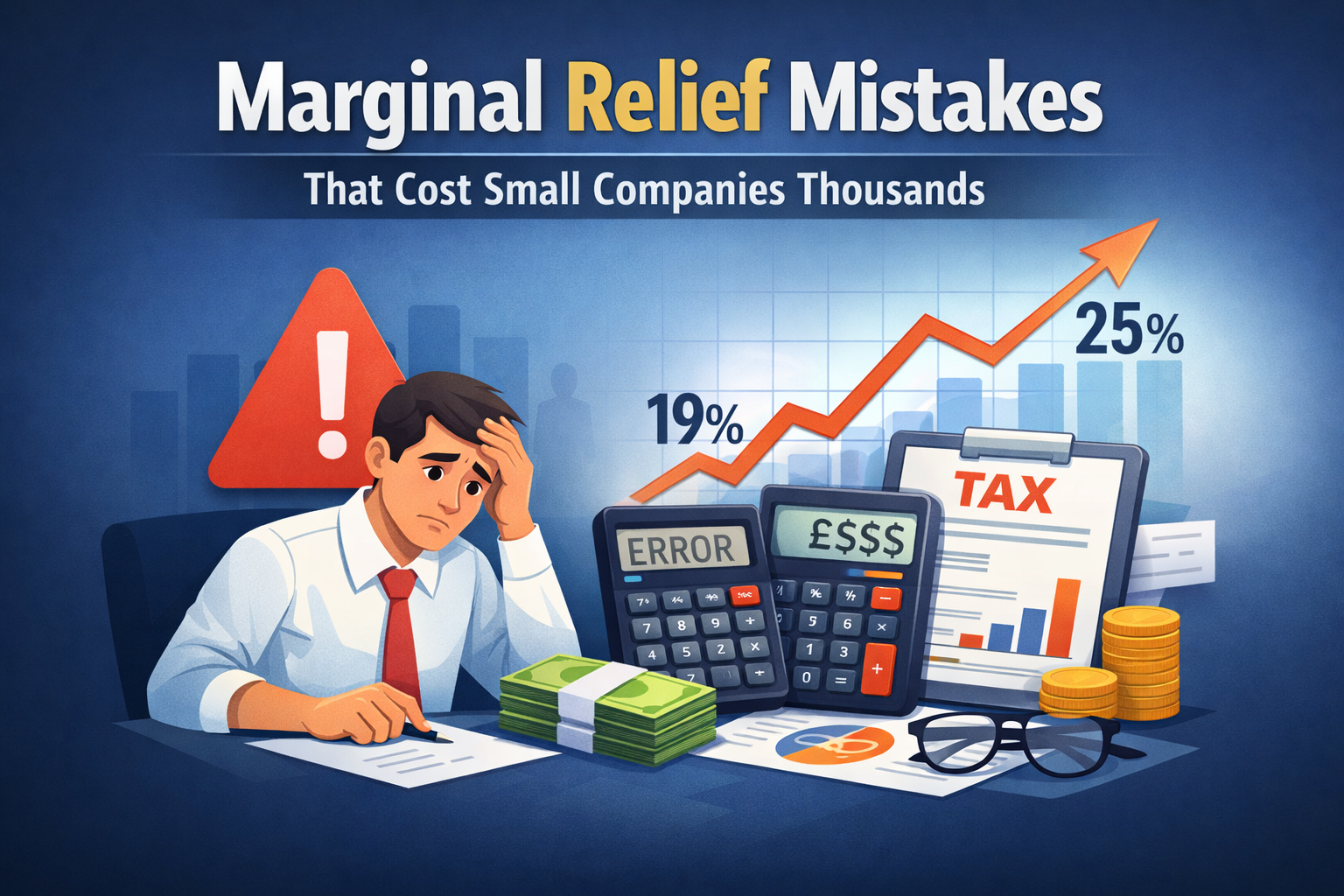
Marginal relief helps businesses that earn profits between £50,000 and £250,000 by giving them a gradual tax increase. Marginal relief is designed to support growing companies by making a tax increase more manageable as profit goes above £50,000. It’s a fair way to avoid paying too much tax as your bank gets bigger. Marginal relief is being designed to provide a gradual increase in the tax payable by companies, which eases the transition from the small (19%) to the main rate (25%).
WHO CAN CLAIM MARGINAL RELIEF:
Eligibility criteria to be able to claim marginal relief are as follows:
- The company should be a UK resident company
- Have a taxable profit between £50,000 and £250,000
If a company is associated with other companies, then the threshold is divided among all the companies. If a company is associated with three companies, then the limits will be divided equally among the total of four companies. Moreover, these thresholds are for an accounting period of 12 months, but if the accounting period is shorter, then limits are apportioned.
WHO CAN NOT CLAIM MARGINAL RELIEF:
A company cannot claim marginal relief if it is one of the following:
- Investment holding company
- Non-UK Resident company
- Taxable profit above £250,000
Companies if they are one of the above, then they have to pay corporation tax according to HMRC.
IMPLICATIONS ON BUSINESS:
Application of Marginal relief have several practical benefits for businesses:
- The cash flow of the company is improved due to lower tax payments.
- Savings from less tax payment can be invested in the company.
- The tax bill for the company would be reduced.
MISTAKES THAT COST THOUSANDS:
1. Short Accounting Period:
Sometimes companies do not apportion the threshold limits as their accounting period is less than 12 months, which results in underpayment of tax and penalties imposed by HMRC as a result.
2. Marginal Relief Calculator:
You may get an error message when you submit your corporation tax figures to HMRC, indicating a mismatch in marginal relief figures. Therefore, HMRC has provided with online marginal relief calculator for companies on its website. This reduces the risk of miscalculation. Not using this helpful tool can cause manual miscalculations, given the complexity of the formula to calculate marginal relief.
3. Categorization of Expenses:
Identification of expenses is important in the calculation of tax liability. However, if the expenses are misclassified or are understated or overstated, they can distort the tax figure, which will result in incorrect calculation of marginal relief and incorrect submission of tax.
4. Associated Companies:
If associated companies are not correctly accounted for, this will affect the calculation of Marginal Relief. The amount of the threshold is equally divided among the associated companies. Having associated companies reduces the taxable profit limits for claiming marginal relief. This means your company may owe more corporation tax to HMRC.
5. Calculation of Augmented Profit:
Augmented profits include taxable total profits plus certain distributions from non-group, unassociated companies. Misclassification or omission of these distributions can result in understatement of profits, leading to an incorrect application of Marginal Relief and potential underpayment of Corporation Tax.
6. Misunderstanding the Effective Tax Rate:
Some businesses mistakenly believe that profits within the Marginal Relief band are taxed at a flat rate. In reality, the effective tax rate increases from 19% to 25% as profits rise from £50,000 to £250,000.
Misunderstanding this can lead to incorrect tax planning and budgeting.
7. Not Adjusting for Changes in Company Control
If control of a company changes during an accounting period (e.g. new shareholders, restructuring), the associated company status may change partway through the year. In this case, the following has to be taken into consideration:
Thresholds may need time apportionment. Associated company numbers can change mid-period.
These are control-related risks about which HMRC is very strict.
7. Marginal Relief as a Planning Tool:
Some businesses attempt to delay invoicing, accelerate expenses, and manipulate profits to stay within marginal relief. Marginal Relief is a mechanical calculation, not a tax incentive. Artificial manipulation can attract scrutiny, especially if repeated year after year. HMRC may challenge the nature of transactions, leading to wider inquiries beyond corporation tax.
9. Failing to Revisit Marginal Relief After Profit Changes:
Marginal Relief calculations are sometimes done early in the year and never revisited. This results in:
- Late-year management accounts showing higher profits
- Adjustments following an HMRC enquiry
- Additional income recognized after year-end
The relief claimed no longer reflects the final profit figure, leading to underpaid corporation tax and interest.
10. Confusing Group Companies with Associated Companies:
A common misconception is that only companies in a formal group structure count as associated. Companies can be associated even without a group, for example, where:
- The same individual controls multiple companies
- Spouses or family members control different companies
- Shareholder agreements create effective control
Companies incorrectly assume they qualify for full thresholds (£50k–£250k) when, in reality, those limits should be split. HMRC frequently challenges this point, leading to backdated tax bills and interest.
11. Overlooking Dividend Timing and Augmented Profits:
Marginal Relief is calculated using augmented profits, which include:
- Taxable profits plus,
- Certain dividends received from non-group companies
Many small companies only look at trading profits. Including dividends can push profits over the marginal relief band entirely, eliminating relief and increasing the effective tax rate unexpectedly.
THE COST OF GETTING IT WRONG:
Individually, each mistake may seem technical. Collectively, they often result in:
- Unexpected corporation tax bills of £5,000 – £20,000 or more
- Interest and potential penalties
- HMRC compliance checks
- Time-consuming correspondence and stress for directors
HOW SUPER FINANCIAL LIMITED HELPS:
- Review and correct Marginal Relief calculations
- Identify and assess associated companies
- Ensure accurate taxable and augmented profit figures
- Apportion thresholds for short accounting periods
- Prevent common calculation errors
- Reassess relief as profits change during the year
- Guide directors on effective tax rates and dividends
- Reduce risk of HMRC penalties and enquiries
CONCLUSION:
Marginal Relief was introduced to soften the impact of higher corporation tax rates, but for many small companies it has become an unexpected source of risk. The rules are technical, the calculations unforgiving, and the margin for error is small. As HMRC increases its focus on compliance in this area, mistakes that once went unnoticed are now being identified even years later.
For small companies, Marginal Relief should be treated as a critical tax calculation, not an automatic adjustment. Regular reviews, careful consideration of company structures, and timely reassessment of profits can make the difference between a compliant return and an expensive HMRC challenge. A proactive review today can prevent a costly surprise tomorrow.
Super Financial Limited is here to support you through this transition.
If you need help completing identity verification or keep your business fully compliant,
Contact us at:
02089250070
We provide professional guidance to keep your business fully safe and satisfied in accordance with the new requirements of Companies House.